Is This an HVAC Problem or a Plumbing Problem?
You’ve got no hot water, a puddle near the furnace, or a smell you can’t place — and two different companies you could call. Here’s the short version: if it involves burning gas, moving air, or heating and cooling your home, it’s HVAC. If it involves water pressure, drainage, or a line that isn’t the gas or ductwork, it’s plumbing. The rest of this guide walks through the calls that don’t split that cleanly, because those are the ones that actually cost homeowners time.
We put this together with a plumbing technician from Rescue Plumbing, because the calls that blur the line are exactly the ones where guessing wrong means a second visit, a second invoice, or both.

Why This Is Confusing in the First Place
HVAC and plumbing systems share a surprising amount of real estate in most Chicago homes. Water heaters sit next to furnaces in the same mechanical closet. Boilers are a plumbing-adjacent heating system. Condensate lines carry water away from your AC using the same kind of drain that clears a sink. And in a two-flat or bungalow with a shared mechanical room, a problem with one system can show symptoms that look like the other.
The good news: almost every case comes down to one question. Is the problem about temperature and airflow, or is it about water and gas moving through pipes? Once you know which, you know who to call.
Quick Reference: Symptom, Likely Cause, Who to Call
|
Symptom |
Likely Cause |
Call |
|---|---|---|
|
No hot water anywhere in the house |
Water heater failure (element, thermostat, pilot) |
HVAC/water heater tech |
|
Hot water inconsistent, but the gas seems to cut out or smell present |
Gas supply or shutoff issue |
Plumber |
|
Furnace won’t run during a cold snap and a pipe has frozen |
Furnace failure is the root cause |
HVAC tech first |
|
A frozen or burst pipe itself, once heat is restored |
Pipe repair |
Plumber |
|
Water pooling near the furnace after a sump or pit failure |
Sump pump or ejector pit |
Plumber |
|
Furnace won’t restart after that flooding |
Water-damaged equipment |
HVAC tech |
|
Boiler is down and a radiator nearby is wet |
Boiler or near-boiler piping |
HVAC tech |
|
Radiator leak farther out in the distribution piping |
Distribution line |
Plumber |
|
Sewer smell through the house, dry basement drain |
Dry trap |
Plumber |
|
Musty or burning smell only when the furnace fan runs |
Ducted odor |
HVAC tech |
|
Water heater swap reveals corroded supply lines |
Supply line condition |
Plumber (same visit as install) |
That table covers the calls we see most often on the seam between the two trades. Here’s the detail behind each one.
“I Have No Hot Water”
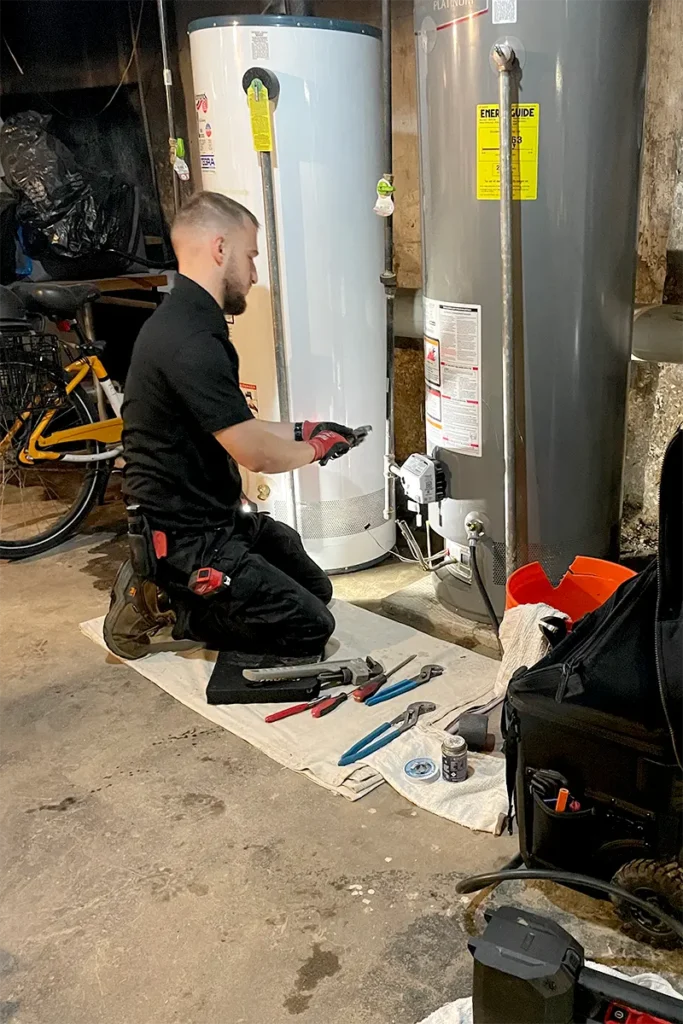
This is the single most common HVAC-or-plumbing question, and it splits cleanly once you isolate where the failure is. If the water heater itself has failed — a bad heating element, a dead thermostat, a pilot that won’t stay lit, or a leaking tank — that’s a water heater repair, which Frontline handles directly.
If the water heater is fine but something upstream of it has failed — the gas supply line, a shutoff valve, or gas pressure to the unit — that’s a plumbing call. Gas supply and shutoff work is squarely Rescue Plumbing’s territory, and it’s worth having a plumber look at the line before anyone replaces a perfectly good water heater.
Also Watch: Water Heater Repair Tips
If these tips don’t fix your water heater or you would prefer to have a professional come out, give our friendly staff a call and we would be happy to send out a plumber for any water heater repair job!
Quick check: if you have a pilot light and it won’t stay lit, or the burner won’t ignite at all even though the tank has power, that points toward a gas supply issue rather than a failed heater.
Frozen Pipe During a Furnace Outage
Cold snaps in Chicago create this exact sequence more than any other seam case: the furnace fails, the house loses heat, and a pipe in an exterior wall or unheated space freezes hours later. The pipe didn’t cause the outage — the outage caused the pipe.
The fix has to happen in order. Restoring heat is the priority call, because a frozen pipe in a heated house tends to stay frozen and static, while a frozen pipe in a cold house is on a clock toward bursting. Once heat is back on, the frozen or burst pipe itself needs a plumber to thaw it safely and repair any split section.
“The two calls we get in the same week every cold snap are ‘my furnace died’ and ‘my pipe burst,’ and half the time it’s the same house, same night. Get the heat back on first — that’s what stops the second call from turning into a flood.” — Ben Vance, Owner of Rescue Plumbing
Sump Failure Floods a Furnace
When a sump pump or ejector pit fails during heavy rain and water reaches a furnace sitting in the basement or a low mechanical room, you’re looking at two separate jobs from two separate causes. The sump pump or pit itself is a plumbing repair — that’s what let the water in.
The furnace, if it’s been sitting in water or had water enter its cabinet, needs an HVAC technician to assess whether it can be dried out and restored or whether the electrical and gas components have to be condemned and replaced. Running a furnace that’s had water intrusion without that inspection is a safety risk, not just a repair question.
Boiler Down With a Wet Radiator
Chicago’s older two-flats and bungalows run more boiler-and-radiator heat than most cities, and this is the seam case that trips up homeowners most often because “it’s a heating system, so it’s HVAC” isn’t quite the full answer.
The boiler itself, along with the near-boiler piping — the connections directly at the unit — is HVAC work. But older systems have long runs of distribution piping carrying hot water or steam out to radiators throughout the house, and a leak somewhere along that run is a plumbing call, not a boiler repair. If your boiler shows normal pressure and the leak is happening at a radiator or along a pipe run well away from the unit, that’s the plumbing side of the system.
Sewer Smell Through the House
A sewer smell is one of the few symptoms that genuinely can come from either system, which makes it worth walking through carefully rather than guessing.
If the smell is strongest near a floor drain, basement bathroom, or laundry area and gets worse when those fixtures haven’t been used in a while, it’s likely a dry trap — the water seal in a drain has evaporated, letting sewer gas back up through the pipe. That’s a plumbing fix, and often a simple one.
If the smell only shows up or gets stronger when the furnace fan kicks on, the ductwork itself may be carrying an odor that started elsewhere in the house — that’s worth a call to an HVAC technician to trace.
Water Heater Swap Reveals Bad Supply Lines
This one isn’t really a “which system” question — it’s a heads-up for anyone scheduling a water heater replacement. It’s common for a tech pulling an old water heater to find that the supply lines feeding it are corroded, undersized, or otherwise due for replacement. When that happens, it’s normal to see two invoices from the same visit: one for the water heater itself, one for the supply line work. Ask your technician directly if this applies before the job starts, so it isn’t a surprise on the invoice.

Rooftop and Multi-Unit Systems: A Different Kind of Seam
Everything above assumes a single-family layout with equipment in a basement. A lot of Chicago housing stock doesn’t work that way — two-flats, three-flats, and courtyard buildings routinely run their condensers on the roof instead of in a side yard, and that changes what “the seam” looks like.
A rooftop cluster like this one means each unit’s refrigerant lines run down through the roof deck to an air handler somewhere inside, and each unit also needs a way to shed condensate — either piped down internally or drained across the roof surface itself. That creates a seam case the ground-floor version of this guide doesn’t cover: a ceiling stain below a rooftop unit.
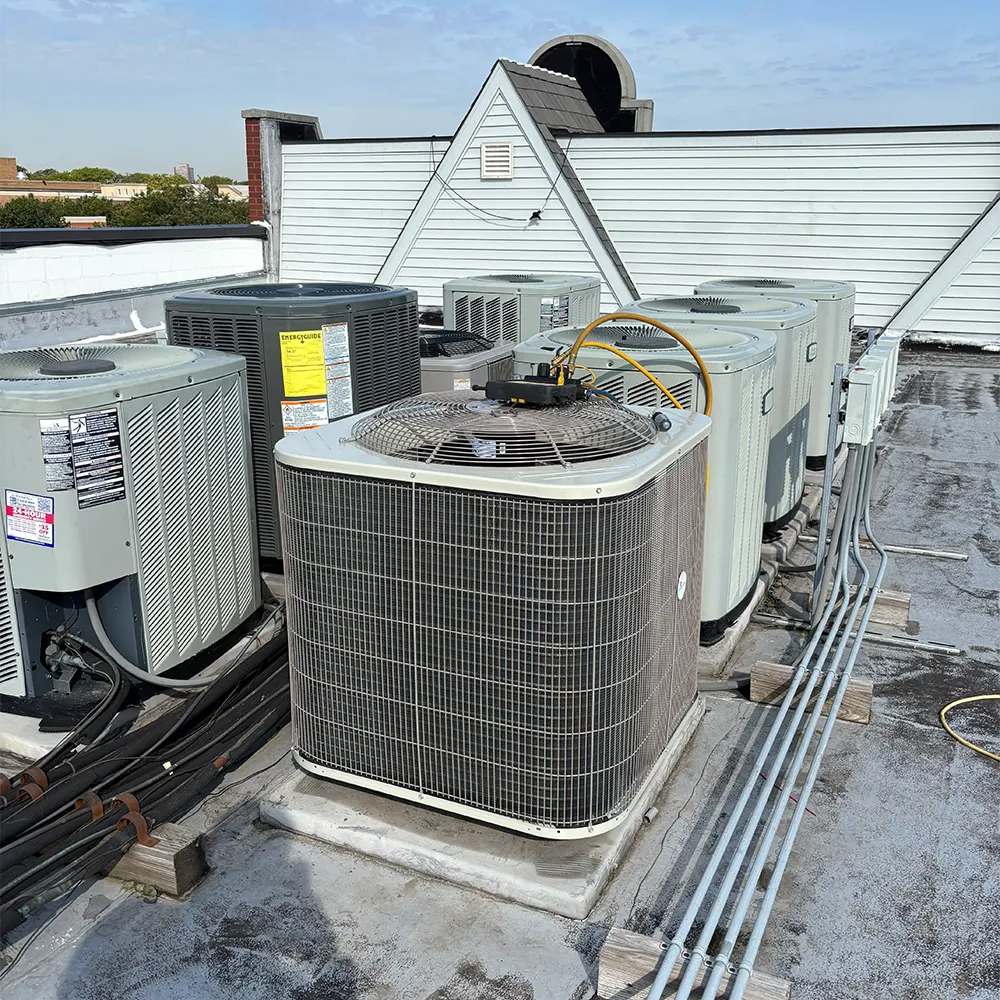
If the stain shows up during or right after the AC runs, and it’s directly under or near a condenser, start with HVAC — a clogged or disconnected condensate line on the roof is the most common cause, and it’s the same fix as the indoor version, just harder to spot. If the stain shows up during or after rain, independent of whether the AC has run, that’s more likely a roof drain, flashing, or membrane issue, which is a roofing call rather than an HVAC or plumbing one. And if a building has a roof drain that ties into the building’s plumbing stack — common in older courtyard buildings — a clog there can cause standing water on the roof that eventually finds its way to a unit anyway, which is when a plumber needs to get involved before the HVAC repair will actually hold.
The general rule from the rest of this guide still applies: describe what you’re seeing and when it happens, rather than guessing at the mechanism, and let the technician who shows up trace it from there.
HVAC vs. Plumbing: When You’re Not Sure Which to Call
If none of the above matches what you’re seeing, the safest default is this: describe the symptom, not your guess at the cause, when you call. “No hot water” gets you routed correctly whether the root cause turns out to be the heater or the gas line. A good dispatcher on either side will ask the right follow-up questions and, if it’s outside their scope, will point you to the right company rather than sending a truck for nothing.
If you’re anywhere in Lakeview, Logan Square, Bronzeville, Humboldt Park, Uptown, South Shore, Oak Lawn, or Orland Park and you’re not sure which call to make, reach out to Frontline first — we’ll tell you straight if it’s a Rescue Plumbing job instead of trying to force it into ours.
What a Frontline Technician Checks First
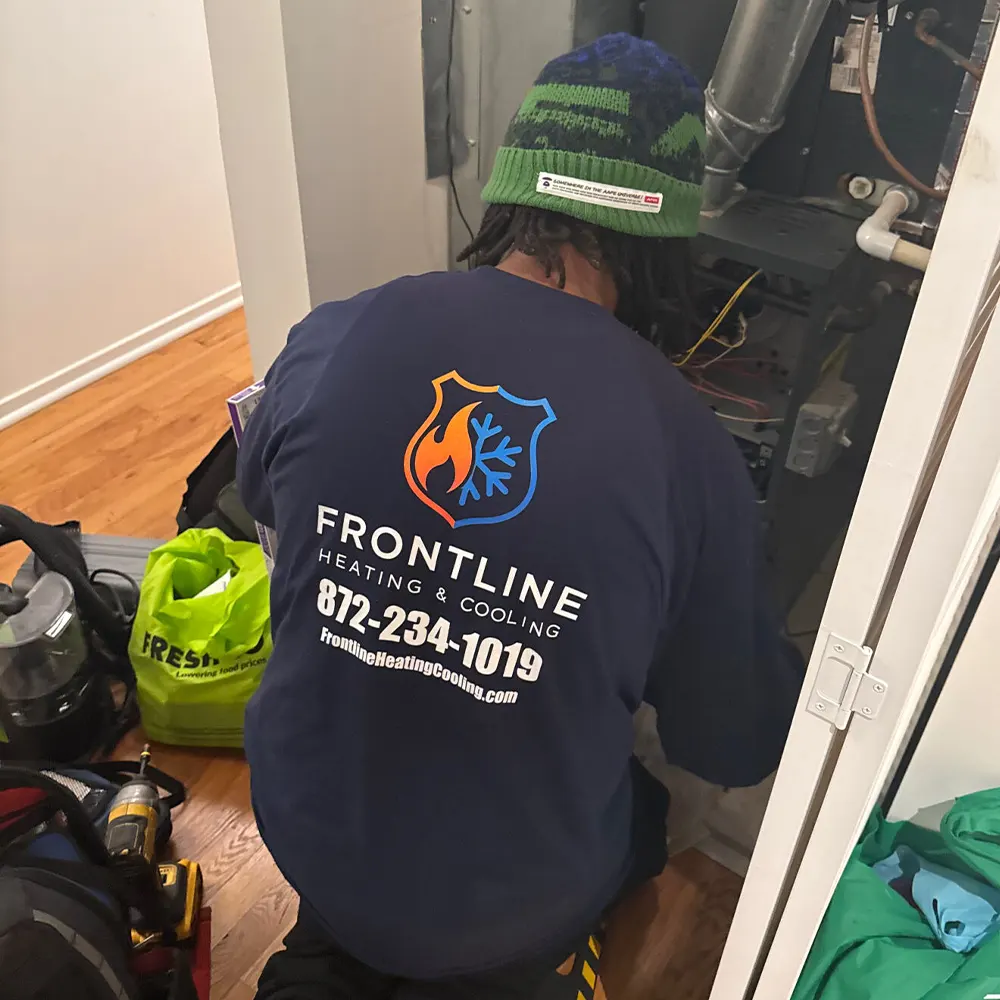
Part of why this split matters is that a good diagnostic starts before anyone touches a wrench. When a Frontline technician arrives on a call like the one above, the first few minutes are spent narrowing down the system, not the fix: checking whether the issue is electrical, mechanical, or gas-related; confirming whether it’s isolated to one piece of equipment or affecting the house more broadly; and ruling out anything on the plumbing side before opening up a panel. That sequence is what keeps a “no hot water” call from turning into a wasted trip if the actual cause turns out to be a gas supply issue upstream of the unit.
It’s a small distinction, but it’s the same logic behind this whole guide: the fastest fix isn’t the first thing a technician touches, it’s the first thing they rule out.